
A reliable purchase of 4-Hydroxy TEMPO (TEMPOL, CAS 2226-96-2) begins with a clear specification and traceable test results. For bulk buyers, a quotation that only states “high purity” is not enough: quality teams need to know which batch was tested, how the assay was measured, what the reported numbers mean and whether the shipment will match the approved sample.
This 4-Hydroxy TEMPO COA checklist explains how to review the certificate of analysis, compare it with the technical data sheet (TDS), and ask the right questions before issuing a purchase order. For the currently published product parameters, refer to the 4-Hydroxy TEMPO product page. This document focuses on analytical and documentation checks; for broader vendor due diligence, see our separate supplier-selection guide.
1. What a TEMPOL COA should identify
A certificate of analysis (COA) is intended to report results for an identified production or supply batch. Before reading the numerical values, verify that the document belongs to the material being offered. The first review should establish identity, traceability and accountability.
- Product identity: the document should clearly state 4-Hydroxy TEMPO, also known as TEMPOL or Inhibitor 701, and CAS 2226-96-2. The molecular formula C9H18NO2 can provide an additional identity cross-check.
- Batch identification: confirm the lot or batch number, manufacturing or testing date where provided, and the manufacturer or issuing laboratory. The drum label and COA should refer to the same lot.
- Specifications and results: distinguish an acceptance limit such as “≥99.0%” from the actual measured value. A specification alone is not evidence that a particular lot passed.
- Test method and authorization: ask which methods apply, when the testing occurred and who approved the release. If a third-party lab issued the report, its sample-to-batch chain should be traceable.
Practical buyer check: if the PDF has no lot number, no actual result or conflicting product names, request a corrected batch-linked document before reviewing price. A supplier may initially share a representative COA, but it should be labeled as such and replaced with the shipment-specific COA before release.
2. How to review assay, moisture, ash and melting point
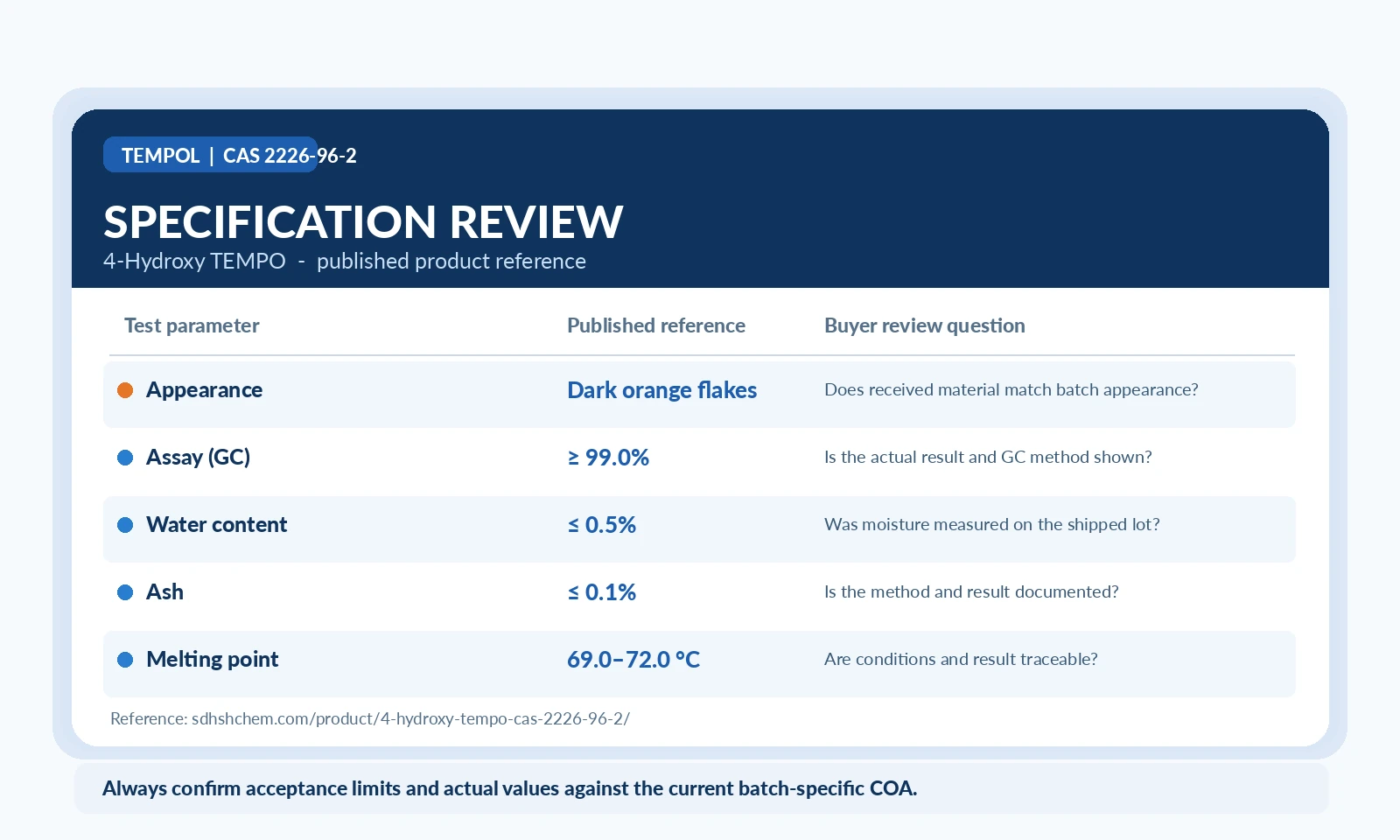
The table below is based on specifications currently published for the product on this website. It is a reference for pre-qualification, not a substitute for a current, signed COA. The agreed purchase specification and results for the proposed lot take precedence.
| Parameter | Published product reference | What procurement should verify |
|---|---|---|
| Appearance | Dark orange flakes | Observed color and form; note unexpected changes or contamination. |
| Assay (GC) | ≥99.0% | Actual lot result, analytical method and reporting basis. |
| Water content | ≤0.5% | Measured result, test method and applicable acceptance limit. |
| Ash | ≤0.1% | Measured inorganic residue, test procedure and limit. |
| Melting point | 69.0–72.0°C | Recorded range, test conditions and agreement with grade specification. |
2.1 Assay (GC): separate purity claims from test results
Assay is the main quantitative indicator on a TEMPOL specification, but it is only useful when the reporting basis is understood. The product page lists GC assay ≥99.0%. In a COA, look for the numerical batch result and the technique used, rather than accepting a generic “99% grade” statement.
- Ask for: assay value, method identification, chromatographic conditions or method reference, and any qualification of the result as area percentage or mass fraction.
- Why it matters: GC peak-area normalization is not automatically equivalent to a calibrated weight-percent assay. Response factors, excluded components and method validation can affect interpretation.
- Escalate when: the method is missing, the COA states only “Pass,” or the reported result is close to your internal minimum and no uncertainty or repeat-test policy is provided.
Where the application has a tightly controlled inhibitor dosage, the buyer’s technical team should agree on the acceptance basis before samples are approved. Do not assume that assays from different laboratories are directly interchangeable without reviewing their methods.
2.2 Water content: confirm the method and receiving limit
The published reference for water content is ≤0.5%. For a moisture-sensitive formulation or a process with strict material balance, request the actual lot result and the analytical method. A Karl Fischer method may be used for certain materials, while loss on drying is a different measurement that can include other volatile components; the two should not be treated as equivalent without validation.
Buyer action: specify the maximum acceptable water content, request the method name and units, and agree whether the supplier must retest after extended storage or repacking. Packaging integrity can be relevant if the drums are opened during consolidation.
2.3 Ash: check inorganic residue, not just overall assay
Ash testing is a way to evaluate residue remaining after a defined treatment, often used as a screen for nonvolatile inorganic contamination. The published product reference lists ash ≤0.1%. Ask for the actual result, the residue or ignition procedure, and how the laboratory reports results below a detection or quantification threshold.
Buyer action: if the process is sensitive to metals or ionic residues, ash alone may be insufficient. Agree separately on any required elemental or other impurity testing instead of assuming that a low ash value proves the absence of all process-relevant contaminants.
2.4 Melting point: use it as a supporting identity and consistency check
The website gives a 69.0–72.0°C melting-point range for 4-Hydroxy TEMPO. External laboratory-grade supplier listings also report melting ranges near this interval, although their own product specifications and purity grades may differ. A melting point can help screen for inconsistency, but it should not replace a validated identification test or assay.
Buyer action: check whether the result is a single temperature or an onset-to-clear-melt range, which instrument or procedure was used, and whether the recorded result falls within the agreed acceptance band. A departure warrants technical review, not an automatic diagnosis of a particular impurity.
2.5 Appearance and additional tests
The published description is dark orange flakes. Appearance should be recorded consistently, but product color is not a stand-alone purity test. Depending on intended use, buyers may additionally request identity confirmation (for example, IR comparison), solution clarity, relevant impurities or evidence of method suitability. These are application-driven requirements and should only be quoted as guaranteed specifications if agreed in writing.
3. COA vs TDS vs SDS vs analytical method
These documents answer different questions. Treating a TDS or safety data sheet as a replacement for a batch COA creates avoidable gaps in incoming-material control.
| Document | Primary purpose | What it does not prove |
|---|---|---|
| COA — Certificate of Analysis | Reports lot-specific tests and results against the applicable release criteria. | Does not, by itself, validate suitability for every end-use or process. |
| TDS — Technical Data Sheet | Summarizes the typical or marketed grade, handling guidance and published specifications. | Typical values are not necessarily measured on the lot being shipped. |
| SDS — Safety Data Sheet | Communicates hazards, safe handling, emergency and storage information under relevant rules. | Safety classification is not a certificate of composition or lot purity. |
| Analytical method / supporting data | Defines how a property was measured, such as GC assay or moisture determination. | A procedure without the batch results does not establish conformance. |
Suggested document sequence: request the current TDS and SDS at RFQ stage; use a representative COA to screen the offered grade; then match the actual batch COA to the shipping lot before final release. If a high-value order depends on a narrowly defined impurity, request analytical support for that specific requirement.
4. Packing, sampling and pre-shipment verification
A technically acceptable COA is necessary but not sufficient when material will be transported and stored in bulk. Review how the proposed shipment will be packed, sampled and identified, particularly when multiple lots are consolidated.
- Packing format: the product page lists 25 kg fiber drums, 20 kg cartons and 25 kg bags as packing options. Confirm which of these is available for the actual quotation, and whether an inner moisture barrier, tamper seal or other protection is included.
- Label consistency: request a sample label or packing photo that shows product name, CAS number, batch number, net weight and any handling identifiers appropriate to the shipment.
- Representative sampling: agree whether the pre-shipment sample comes from the same production lot and how it is sealed, retained and labeled. Record sample quantity and collection date.
- Testing before dispatch: for a first order or sensitive process, establish whether an independent laboratory or buyer-side test is required, which methods apply and who pays if results disagree.
- Storage and transit: obtain the current SDS and supplier-specific storage instructions. Confirm the manufacturer’s declared shelf life and any temperature or humidity controls for the planned route rather than assuming all suppliers have identical conditions.
Decision rule: approve the sample against a written specification, then make shipment acceptance conditional on a matching lot number and a conforming lot-specific COA. For repeat orders, retain prior COAs to review consistency over time.
5. Five-point RFQ checklist for bulk buyers
A short but precise RFQ reduces unnecessary email rounds. Include the following five items when requesting TEMPOL specifications and a bulk quote:
- Identify the required product and grade. Specify 4-Hydroxy TEMPO (TEMPOL / Inhibitor 701), CAS 2226-96-2, required assay and any application-specific constraints.
- Define measurable acceptance criteria. State required GC assay, maximum moisture and ash, melting-point range and any additional tests, with methods or standards when critical.
- Request the right documents. Ask for current TDS and SDS, a representative COA for screening, and a batch-specific COA for the proposed shipment.
- Describe commercial and logistical needs. Provide quantity, forecast consumption if relevant, desired packing, delivery country/port, lead-time expectations and preferred trade terms.
- Agree on the verification process. Confirm sampling, labeling, pre-shipment inspection, handling of out-of-spec results, and who will approve the first commercial lot.
“Please quote 4-Hydroxy TEMPO (CAS 2226-96-2) for [quantity] delivered to [destination]. Provide the proposed grade, current TDS/SDS, a representative COA and available packing formats. Confirm the assay method (GC), moisture, ash, melting-point limits, sample availability and estimated lead time. A batch-specific COA will be required before dispatch.”
6. Common procurement questions
Is a COA showing “≥99%” enough to release a shipment?
Not on its own. The COA should identify the specific batch and show the actual assay result and relevant supporting parameters. Incoming inspection may still be required by your purchasing or quality agreement.
Can a buyer compare GC assay values from different suppliers directly?
Only with care. First check that the reported basis, test method, calibration and treatment of impurities are comparable. “GC 99%” on two documents may not describe an identical analytical procedure.
What if a representative COA meets the limit but the shipment COA does not?
The shipment should be assessed against the agreed acceptance specification and contract terms. Request investigation and corrective documentation; do not substitute an older representative COA for the delivered lot’s result.
Are supplier TDS values guaranteed for every batch?
Not necessarily. A TDS can describe typical values or marketed limits. Request written confirmation of guaranteed limits and a batch-specific COA showing actual measured results.
Request a product-specific COA/TDS and a bulk quotation
Before purchasing 4-Hydroxy TEMPO in bulk, send your target grade, expected quantity, application-specific test requirements, preferred packaging and destination. Our team can review the applicable published product specifications and provide available technical documentation and a quotation for your requested shipment.
Request a product-specific COA/TDS and a bulk quotation. Provide your target grade, quantity and destination for review.
Request a COA & Bulk QuoteRelated reading: 4-Hydroxy TEMPO — CAS 2226-96-2 product specifications · How to choose a reliable 4-Hydroxy TEMPO supplier.
Technical note: the figures described as “published reference” are drawn from the website’s currently published product page and should not be interpreted as a COA for an unverified lot. Illustrated images are not proof of actual laboratory testing.