Chemical Procurement Guide / Glyoxal 40% / CAS 107-22-2
When comparing Glyoxal 40% suppliers, concentration alone is not enough. Residual formaldehyde, total acidity, glycol content and color may influence a buyer’s specification review. This guide to Glyoxal 40% formaldehyde grades explains how to compare specification tiers, interpret supporting documents and request the right material before placing a bulk order.

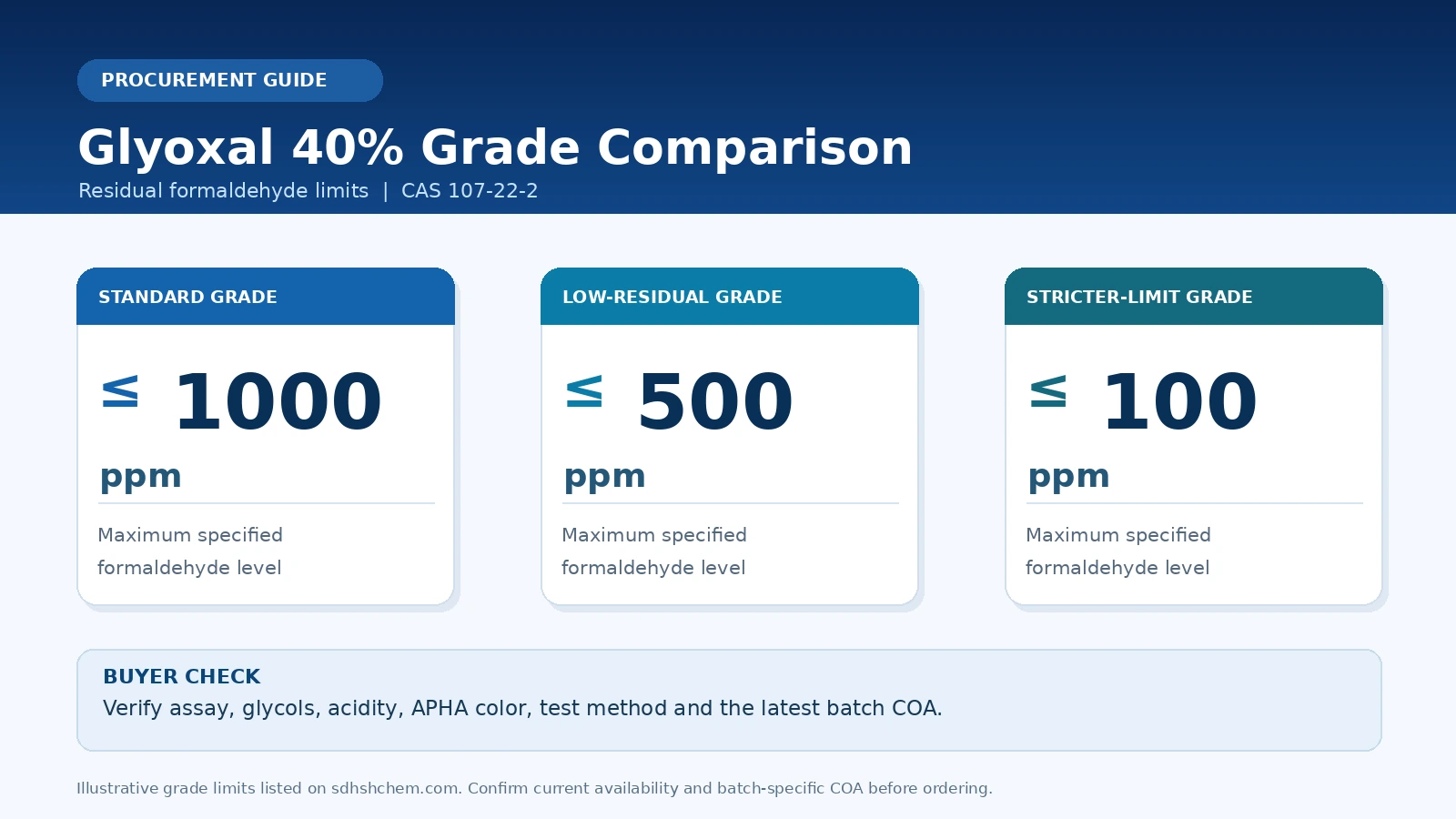
Quick answer: The supplier’s published Glyoxal 40% product overview describes formaldehyde specification tiers of ≤1000 ppm, ≤500 ppm and ≤100 ppm. These are grade limits, not guaranteed results for every shipment. Always confirm current availability and the latest grade-specific COA.
1. What Buyers Mean by a Glyoxal 40% Grade
Glyoxal 40% is an aqueous solution of glyoxal (CAS 107-22-2). Two quotations can both state “40%” while referring to different impurity limits and quality-control requirements. For technical procurement teams, the word grade usually means a defined set of acceptance criteria—not just the nominal assay.
Residual formaldehyde is often a useful first screening parameter. A specification such as “≤500 ppm” sets an upper limit for the measured formaldehyde content under the agreed test method. It does not mean each batch contains exactly 500 ppm. Likewise, a stricter limit does not, by itself, establish better performance for every formulation.
Before comparing prices, ask whether suppliers are quoting the same grade, the same test basis and comparable documentation. Otherwise, a lower unit price may reflect a different specification rather than a like-for-like commercial offer.
2. Comparison Matrix: 1000 / 500 / 100 ppm Formaldehyde Limits
The table below summarizes the residual-formaldehyde tiers shown in Huashihang Chemical’s published Glyoxal 40% information. Use it to prepare an RFQ, while treating the most recent specification sheet and batch COA as the controlling references.
| Evaluation item | 1000 ppm tier | 500 ppm tier | 100 ppm tier |
|---|---|---|---|
| Nominal Glyoxal concentration | 40% | 40% | 40% |
| Residual formaldehyde limit | ≤1000 ppm | ≤500 ppm | ≤100 ppm |
| Procurement action | Confirm standard-grade acceptance | Confirm lower residual limit | Confirm supply and testing capability |
Important: These values identify published specification limits, not actual batch readings or a promise of current inventory.
For buyers considering a lower-residual option, the website also lists a Glyoxal 40% formaldehyde 500 ppm product link. Confirm the current product details with the sales team, as website routes and product listings can change.
3. Other Parameters: Assay, Glycols, Total Acidity and APHA
The formaldehyde limit is only one part of a useful Glyoxal 40% specification. Procurement and quality teams should review the following items together:
- Glyoxal assay: Request the test result and specified minimum concentration. Confirm that suppliers use compatible concentration and reporting bases.
- Glycols: Check the applicable glycol impurity limit and analytical method, particularly where downstream reactions are sensitive to raw-material composition.
- Total acidity: Compare the stated limit, units and calculation basis. Do not assume an acidity figure on one product sheet automatically applies to another grade.
- APHA / Pt-Co color: Review the color limit where appearance or process consistency matters. Ask for the current result rather than relying only on a catalogue description.
Huashihang’s public specifications reference a 40% minimum assay, glycols and APHA color requirements, but document versions can differ in their acidity limits. That is precisely why a current, grade-specific COA and TDS should be checked together. For a separate technical explanation of acidity and appearance, see the existing article on Glyoxal 40% acid components, pH and color.
4. Application-Specific Acceptance Criteria and Test Methods
Different downstream processes may require different limits. A paper or textile formulation may prioritize consistency during production trials, while a synthesis route may impose tighter impurity controls based on its own validated quality requirements. The purchasing decision should follow the end user’s actual process specification—not a generic assumption that the lowest ppm figure is always necessary.
When discussing a new supply source, ask the technical team to identify any critical-to-quality parameters and their acceptable ranges. Then confirm the laboratory method used for formaldehyde determination, the unit basis, detection capability and how results are reported. If two COAs use different methods, apparent numerical differences may require technical interpretation before approval.
For supply chains involving Glyoxylic Acid 50%, raw-material selection should be reviewed alongside the requirements of the downstream conversion process. A product’s intended use does not automatically establish suitability for any regulated or sensitive application; buyers must complete their own qualification and compliance review.
Practical acceptance checklist
- Specify the required maximum formaldehyde limit and assay range.
- Record glycol, total acidity, color and any process-specific criteria.
- Agree on test methods and the units used on the COA.
- Review a representative sample or production trial where needed.
- Confirm labeling, packaging, handling instructions and destination requirements.
5. How to Request a Grade-Specific COA and Quotation
A well-defined RFQ helps the supplier respond with an appropriate offer. State the target residual-formaldehyde tier—≤1000 ppm, ≤500 ppm or ≤100 ppm—together with your annual or trial quantity, receiving country, intended application and any special test requirements. For the 100 ppm option, explicitly confirm current production availability and feasible order volume.
Request the latest TDS, a recent representative COA and the SDS for review. Before shipment, ask how a batch-specific COA will be linked to the delivered lot. Also confirm packaging preferences, incoterms, lead time, sample availability and quotation validity. The website identifies common industrial formats including drums, IBCs and ISO tanks, subject to the actual offer.
When reviewing several suppliers, use a single comparison worksheet with separate columns for specification compliance, documentation, packing, delivered cost and lead time. This makes it easier to evaluate the total purchasing decision and reduces the risk of comparing different materials under the same product name.
Request a Product-Specific COA/TDS and Bulk Quotation
Tell us your target grade, order quantity and destination. Our team can review your requirements and confirm the currently available specification and supporting documentation.
Request a QuotationEmail: info@sdhshchem.com
Technical note: Grade limits and supply options should be confirmed against the latest manufacturer-issued documents. This article is a purchasing guide, not a certificate of analysis or regulatory certification.