TECHNICAL PROCUREMENT GUIDE · CAS 298-12-4
For Glyoxylic Acid 50% (CAS 298-12-4), a label such as “technical” or “cosmetic” is not a substitute for numerical acceptance criteria. A purchasing decision should be based on the required glyoxylic acid concentration, residual glyoxal, oxalic acid, color, iron and supporting documentation. Each supplier quotation also needs to be tied to a clearly identified grade and a traceable production batch.
This article provides a practical way to read Glyoxylic Acid 50% impurity specifications, identify missing laboratory information and avoid accepting an unsuitable lot. It focuses on analytical review and purchasing decisions rather than repeating a general grade-selection overview.

1. Why grade names alone are not enough
Glyoxylic acid is commonly purchased as an approximately 50% aqueous solution. Two offerings may show the same nominal concentration while allowing very different amounts of residual glyoxal, oxalic acid and iron. The practical question is not simply “Which grade is better?” It is “Which documented combination of limits is acceptable for this process and finished product?”
For example, a synthesis route may have an established impurity clearance step, whereas an appearance-sensitive formulation may need tighter color and metal controls. Neither case can be decided from the word “cosmetic” alone. The buyer should first agree internally on a specification and then ask a supplier to identify a grade that can meet it consistently.
- Product identity: 50% glyoxylic acid solution, CAS 298-12-4, with the assay basis explicitly stated.
- Numerical acceptance criteria: separate maximum values for glyoxal, oxalic acid, iron and color.
- Quality evidence: a current grade specification plus a batch-specific Certificate of Analysis (COA).
- End-use review: application suitability and any downstream safety or regulatory requirements confirmed by the purchaser.
What the public pages show
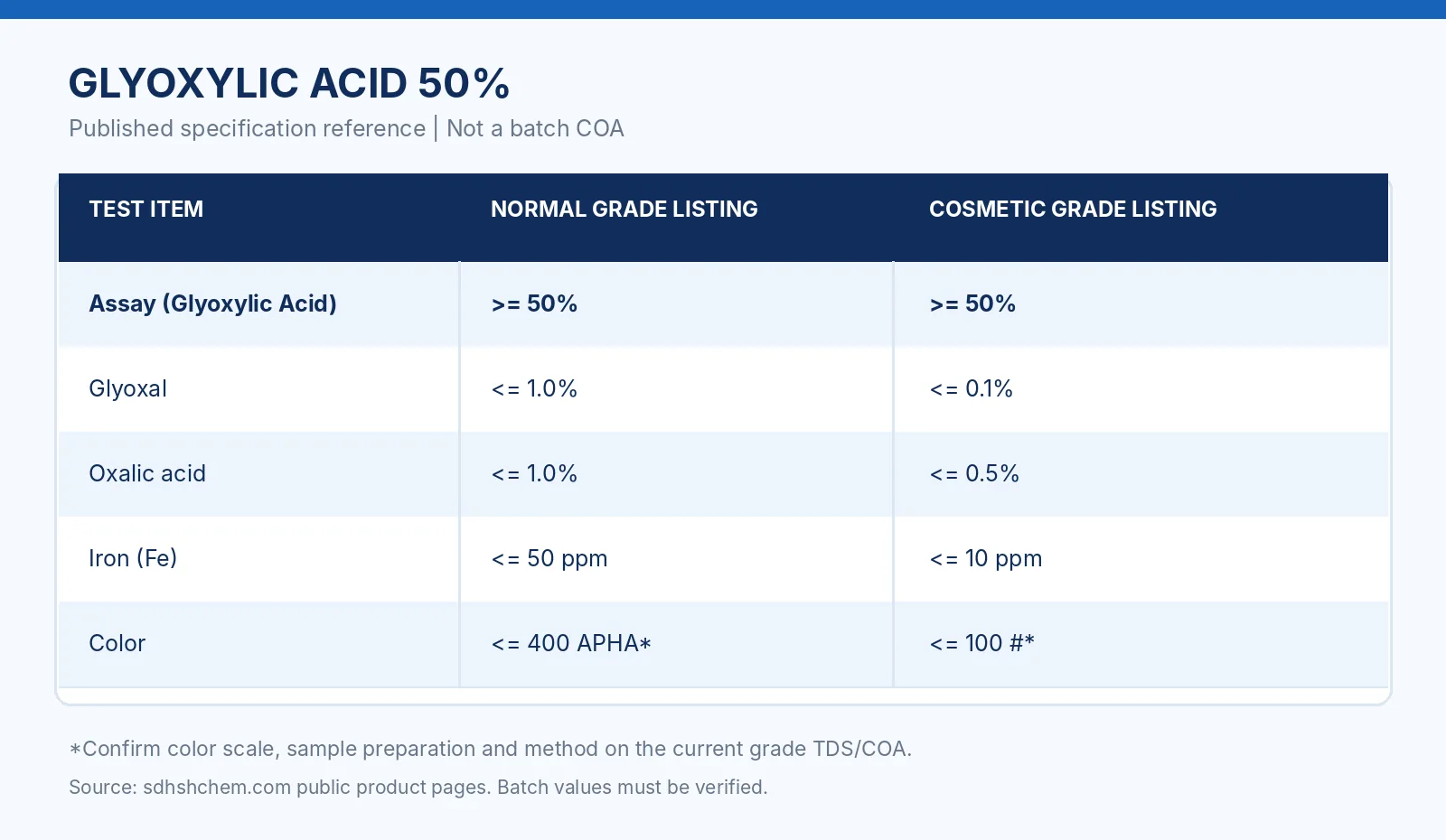
The standard product listing presents glyoxal ≤1.0%, oxalic acid ≤1.0% and iron ≤50 ppm; a separate cosmetic-grade listing presents tighter values. These are published grade specifications, not actual measured batch results. Verify the current TDS and COA before making a purchasing commitment.
2. Glyoxal residue, oxalic acid, color and iron: what to request
Residual glyoxal: define the limit and the method
Glyoxal may be present as a residual impurity in glyoxylic acid supply. Buyers should request its result as a percentage by mass, rather than accepting a broad “low glyoxal” claim. Ask whether the supplier uses an appropriately validated chromatographic or other analytical method for the sample matrix. A numerical result without a named method may be difficult to compare with a result from another laboratory.
A lot targeting a 0.1% maximum requires a different acceptance review from one allowed up to 1.0%. Where results are close to the boundary, confirm the reporting basis, rounding convention and method performance before issuing a release decision.
Oxalic acid: check the independent maximum
Oxalic acid is a separate impurity line and must not be inferred from the glyoxal value. Request its mass-fraction limit, batch result and test method independently. For example, a formulation could satisfy a residual-glyoxal target yet still be unsuitable if its oxalic acid level exceeds the buyer’s process-specific limit.
Color: compare the same scale under the same conditions
Color may matter for appearance-sensitive downstream products, but the number is meaningful only when the scale and test conditions are clear. The older site reference identifies the normal-grade color as ≤400 APHA, while the cosmetic product page shows a color value of ≤100 with a “#” notation. Do not assume these are directly comparable until the supplier confirms whether the latter is also reported in APHA/Pt-Co units and supplies the test procedure.
Iron: check ppm and the analytical basis
Iron (Fe) is reported on the site at ≤50 ppm for the standard listing and ≤10 ppm for the cosmetic listing. Ask whether the result is measured on the supplied solution, which sample preparation was used and which method produced the reported value. For other trace metals, request an additional elemental-impurity panel only when relevant to your application and applicable requirements.
3. How to read a specification limit versus a batch test result
A specification states what a lot must meet. A COA normally records what was measured for that identified lot. For example, a specification might say “glyoxal ≤0.10%,” while the actual COA reports “0.08%.” The first figure is a ceiling; the second is a measurement. Procurement teams should preserve both values in their approval records.
| COA field | What the buyer should check | Why it matters |
|---|---|---|
| Specification / maximum | Target threshold and reporting unit | Defines pass/fail acceptance |
| Actual result | Numeric value, not just “passes” | Shows proximity to the limit |
| Method / reference | Analytical technique or method identifier | Supports consistent comparisons |
| Batch number | Matches drum labels and dispatch records | Establishes traceability |
| Date / authorization | Test or release date, issuer and document control | Helps verify document currency |
Example (hypothetical, not an HSH COA): for a buyer limit of glyoxal ≤0.10%, a measured value of 0.08% is numerically within the limit; 0.12% is not. If the report says “not detected,” request the detection or quantitation limit to understand what that statement means. Avoid treating “ND” as an absolute zero.
4. Build a grade matrix only from verified COAs
A public product specification is a useful starting point for supplier discussions, but it does not show the performance of a specific batch. Start with the two site-listed grade profiles below, then build a final side-by-side approval matrix only when you have received recent, batch-linked COAs for the grades under consideration.
| Property | Standard product page (published) | Cosmetic-grade page (published) |
|---|---|---|
| Glyoxylic acid assay | ≥50% | ≥50% |
| Glyoxal | ≤1.0% | ≤0.1% |
| Oxalic acid | ≤1.0% | ≤0.5% |
| Iron (Fe) | ≤50 ppm | ≤10 ppm |
| Color | ≤400 APHA in prior technical article | ≤100 “#”; verify APHA basis |
Approval sequence: (1) obtain the applicable latest TDS; (2) obtain a recent COA identifying an actual batch; (3) enter each result, limit and method into a comparison sheet; (4) highlight any missing or mismatched units; and (5) obtain technical sign-off or request a sample before approving the grade. Never fill an unknown COA cell with a product-page target.
For an existing explanation of the conventional product range, see the technical-grade 50% solution overview. The purpose here is the document-level acceptance process rather than a generic ranking of grades.
5. Methods, documents and sample verification
A complete technical purchasing package usually includes a specification/TDS, the SDS for safe handling and a recent grade-specific COA. If a result is business-critical, ask for the analytical method or testing standard. The SDS is a safety document and should not be used as a substitute for batch analytical evidence.
- Before sampling: confirm requested batch, lot size, retention-sample availability and agreed sampling procedure.
- During laboratory review: match sample labels to the COA and record temperature, appearance and any relevant dilution procedure.
- For disputes: agree in advance which laboratory and method will govern a re-test, including how borderline results are handled.
- Before dispatch: reconcile batch numbers, packaging labels, packaging integrity and final release documents.
Do not assume a “cosmetic-grade” designation alone establishes regulatory suitability for every market or finished formulation. The downstream manufacturer remains responsible for reviewing product safety, intended use and local compliance requirements.
6. RFQ template for downstream users
A strong RFQ reduces repeated emails and gives the technical team enough detail to propose a suitable option. You can copy the following request and adjust the limits to your own approved specification:
Subject: Glyoxylic Acid 50% (CAS 298-12-4) – Grade, COA and Bulk RFQ
Please quote Glyoxylic Acid 50% aqueous solution for [application] and [annual/monthly quantity]. Our acceptance criteria are: glyoxal ≤[X]%, oxalic acid ≤[Y]%, iron ≤[Z] ppm and color ≤[value + named scale]. Please send the current grade TDS, SDS, a recent batch-specific COA and the relevant analytical-method references. Confirm drum/IBC availability, sample policy, lead time, Incoterm and destination [port/country].
For commercial specifications and available packaging, start from the main Glyoxylic Acid 50% product and the cosmetic-grade listing. If your team is also reviewing upstream raw materials, the Glyoxal 40% product page provides separate product information.
7. Buyer questions and next steps
Is a 0.1% glyoxal grade always preferable?
Only if the tighter limit is justified by your process, product requirements or internal risk assessment. Price, testing methods, availability and qualified suppliers also matter. Do not pay for an unnecessarily tight limit without a defined acceptance rationale.
Can I compare a color value of 100 with APHA 400 directly?
First confirm the reporting scale and method on both documents. The site uses different notation for the two public listings, so a direct comparison should not be assumed until technical documentation clarifies it.
What if the supplier provides only a TDS?
A TDS can confirm target limits but cannot demonstrate whether a particular production lot meets them. Request a batch-linked COA before final release and consider an agreed incoming inspection for critical impurities.
Practical takeaway
Buy Glyoxylic Acid 50% against agreed limits, not labels. Record four essentials—glyoxal, oxalic acid, color and Fe—together with a genuine batch result and a comparable test method.
Request a product-specific COA/TDS and a bulk quotation
Tell our team your target grade, required specification limits, estimated quantity, packaging preference and destination for review.