
Polyglyceryl-6 Caprylate and Polyglyceryl-6 Caprylate/Caprate look almost identical in a product catalogue, but their names describe different fatty-acid components. For personal-care ingredient buyers, the distinction matters when checking an INCI declaration, a certificate of analysis (COA), formulation performance and the correct purchasing specification. This guide explains how to verify the offered commercial grade before comparing prices or placing a bulk order.

1. Why the Two INCI Names Are Not Interchangeable
Polyglyceryl fatty-acid esters are a family of materials made from polyglycerol and fatty-acid components. The number “6” describes the nominal or average polyglycerol component; it does not mean that every commercial batch contains one perfectly uniform molecular species. The fatty-acid portion of the name therefore matters.
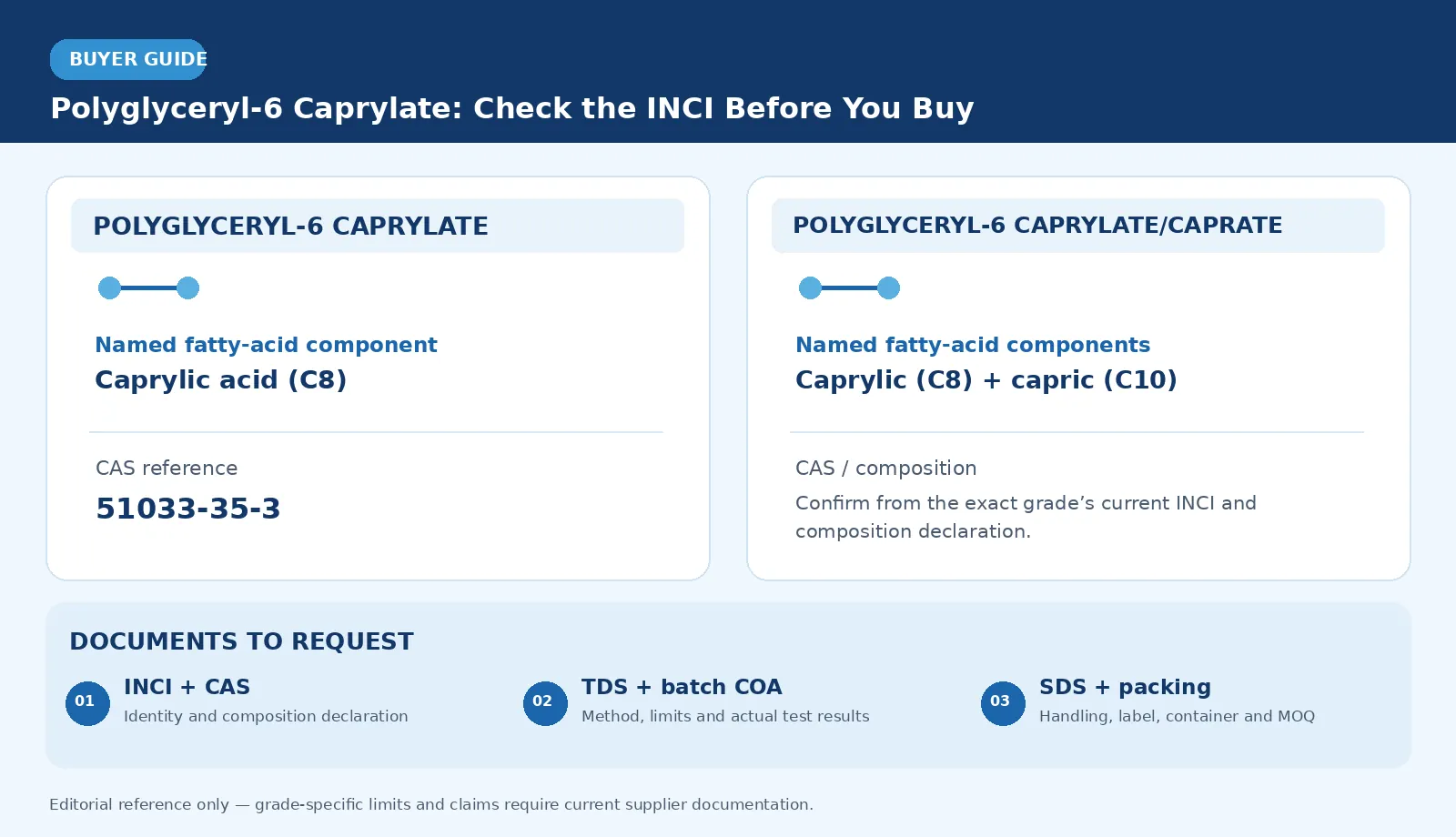
Polyglyceryl-6 Caprylate names an ester associated with caprylic acid (an eight-carbon, C8 fatty acid). The separately listed INCI name Polyglyceryl-6 Caprylate/Caprate includes caprylic (C8) and capric (C10) components. A buyer should not assume that the two names describe an identical composition, fatty-acid distribution or performance profile.
For Polyglyceryl-6 Caprylate, CAS 51033-35-3 appears in recognised ingredient identity references, including Health Canada’s ingredient database. This reference should not be copied automatically onto a Caprylate/Caprate blend without a grade-specific supplier declaration. If a website, product label and TDS show different names, request clarification before approving artwork, registration documents or a purchase order.
2. The Four Checks That Establish Ingredient Identity
A supplier may use a broad catalogue title to attract inquiries for multiple related materials. That can be practical for searching, but purchasing records need an exact identity. The following sequence prevents miscommunication between procurement, quality assurance and the formulation team.
Check 1 — The declared INCI name
Ask the supplier to confirm the official INCI name for the specific offered grade, and whether the item is a single named polyglyceryl ester family or an intentionally blended product. Request a written declaration suitable for the destination market’s ingredient review.
Check 2 — CAS and composition
Match the CAS information against the INCI declaration. Where several fatty-acid esters or formulation aids are present, ask whether the CAS refers to one constituent, the principal ingredient or a separately defined commercial mixture. Where confidentiality applies, request the composition information required for your regulatory assessment under an appropriate confidentiality arrangement.
Check 3 — Trade name and grade code
Record the manufacturer’s grade code, actual producer and revision of the TDS. Two products marketed as “polyglyceryl emulsifier” can have different analytical values and processing behaviour. A grade code reduces the chance of receiving a substitute with a similar sales name.
Check 4 — Sample and commercial batch consistency
Confirm that the sample, quotation, COA and final container label identify the same grade. Ask whether the approved sample represents routine commercial production, and whether changes to raw materials or manufacturing process are covered by a supplier change-notification procedure.
3. How to Read Technical and Batch Specifications
After identity is settled, quality teams can compare measurable parameters. The TDS normally describes a supplier’s specification or typical characteristics, while a COA should report results for an identified batch. Both are useful, but they answer different questions. A numerical value copied from another supplier’s website is not a valid acceptance limit for the material being purchased.
| Review field | What it tells the buyer | What to verify |
|---|---|---|
| Appearance / colour | Quick consistency check for an offered liquid grade | Visual standard, lighting and any colour method |
| Acid value | An analytical indicator of titratable acidic groups | Unit (mg KOH/g), method, limit and batch result |
| Saponification value | Characteristic of the ester-containing material | Method, reporting unit and approved range |
| Iodine value | Information related to unsaturation | Whether tested, units and relevance to the grade |
| Water / moisture | Potential impact on storage and formulation balance | Whether reported and the method used |
| Trace impurities | Application-specific quality and safety review | Metals, residuals or microbiology only when relevant |
| Composition / fatty acids | Whether C8-only or C8/C10 is correctly described | Available composition declaration and analytical basis |
Acid value and saponification value are not interchangeable purity figures. They describe different chemical characteristics, and a “better” number cannot be selected without reference to an agreed specification and method. Likewise, an HLB value shown on a catalogue page may be calculated rather than measured; ask for its basis before using it as a formulation-selection criterion.
For each critical specification, record five columns in your internal approval sheet: test item, unit, acceptance limit, method, and batch result. Where an item is shown only as “typical” rather than guaranteed, confirm whether it belongs in your purchase specification or only in a development reference.
4. COA vs TDS vs SDS vs Composition Declaration
Four documents frequently appear in an ingredient purchase file. Each has a distinct purpose and none should be used as a substitute for the others.
| Document | Primary purpose | Main buyer action |
|---|---|---|
| COA | Evidence of a batch’s reported test results | Match batch number, method, limit and measured result |
| TDS | Technical profile and suggested operating information | Check document revision and intended grade |
| SDS | Hazard communication, handling and transport guidance | Review current version for destination and use |
| INCI / composition statement | Ingredient naming and composition support | Resolve Caprylate versus Caprylate/Caprate identity |
If the commercial product is a blend, a single line labelled “purity” may be insufficient to establish composition. Ask what the number measures, how it is calculated, and whether additional formulation aids are included. Record any agreed deviations in writing before approving production quantities.
5. Performance Questions for Personal-Care Formulations
Polyglyceryl ester ingredients may be evaluated for surfactant, solubilising or co-emulsifying roles, depending on composition and the complete formulation. Actual performance depends on the other surfactants, oils, electrolytes, fragrance materials, temperature and processing sequence. Buyers should therefore request grade-specific formulation data rather than rely on an unqualified statement that a raw material “works in all cosmetics”.
Cleansing and solubilisation systems
For a micellar product, facial cleanser or clear rinse-off base, ask for solubilisation examples and the exact surfactant system used in the supplier’s demonstration. Evaluate clarity, viscosity, foam profile and stability in your own base. A result from one formula does not automatically transfer to a different fragrance load or electrolyte level.
Emulsions and sensory performance
When the material is proposed as a co-emulsifier, assess droplet stability, phase separation, texture and process compatibility. The TDS may recommend an addition stage or operating temperature, but formulation trials should confirm these conditions. Request comparable benchmarks if the supplier claims the grade can replace another ingredient.
Preservation and regulatory boundaries
Do not interpret an ingredient’s surfactant properties or marketing description as proof that a finished cosmetic can be sold without a preservative. Any antimicrobial or preservative-support claim requires appropriate evidence and, where relevant, finished-product preservation testing. Food, oral-care or medicinal uses also require separate suitability and regulatory review; they should not be inferred from a cosmetic raw-material description.
6. Sample Qualification, Packing and Traceability
Before moving from a small sample to a 25 kg or larger commercial lot, buyers should confirm that qualification results are reproducible at the intended scale. The supplier’s existing page mentions 25 kg and 200 kg drums; treat these as published packaging options requiring quotation-stage reconfirmation, not a guarantee that every grade and destination uses the same container.
- Sample traceability: request sample lot ID, production date, packaging date if available, and the corresponding sample COA.
- Comparative tests: run the candidate and approved reference under identical dosing, temperature, mixing order and observation periods.
- Storage stability: monitor the sample under the planned warehouse and production conditions; record appearance and any separation or change.
- Commercial packaging: confirm net weight, drum material, seal type, palletisation, container compatibility and available tamper evidence.
- Delivery controls: agree on labelling, batch identification, shelf-life basis and what happens when received material differs from the approved sample.
The correct storage instruction should come from the supplied SDS/TDS and packaging recommendation. Avoid inventing a universal shelf life, since it can depend on the grade, container and conditions.
7. Bulk Buyer RFQ Checklist and Message Template
A precise RFQ reduces back-and-forth questions and makes competing quotations genuinely comparable. Send the following information when asking a supplier to quote Polyglyceryl-6 Caprylate or Polyglyceryl-6 Caprylate/Caprate:
- Identity: intended INCI name, CAS reference and any approved commercial grade code.
- Application: type of finished product and the regulatory market, without sharing confidential formula details unnecessarily.
- Specifications: required analytical fields, units, methods, limits and documentation.
- Trial: sample size, trial schedule and any reference sample used for comparison.
- Commercial terms: order quantity, projected annual demand, packing format and destination.
- Quality process: batch COA, change notification, shelf life, labelling and dispute procedure.
Subject: RFQ – Polyglyceryl-6 Caprylate / Caprylate-Caprate – [Quantity] – [Destination]
Hello, we are evaluating a polyglyceryl ester ingredient for a personal-care formulation. Please confirm the exact INCI name, CAS reference, composition or grade code for the material you offer. Kindly send the current TDS, SDS, a representative batch COA and available sample information.
Our estimated order is [quantity], with delivery to [destination]. Please quote available packaging, MOQ, lead time and commercial terms. We will review the documents and sample before confirming the final grade. Thank you.
8. Frequently Asked Questions
Is Polyglyceryl-6 Caprylate the same as Polyglyceryl-6 Caprylate/Caprate?
No automatic equivalence should be assumed. The names identify different fatty-acid components. Confirm the grade’s current INCI, composition and supporting technical documents before treating them as substitutes.
Can I use CAS 51033-35-3 for either name?
That CAS is documented for Polyglyceryl-6 Caprylate. For a Caprylate/Caprate product, ask the supplier for the correct grade-specific identity declaration rather than assigning the same number without verification.
Which figures must be shown on the COA?
The exact list follows the agreed product specification. Common review candidates include appearance, acid value and saponification value. Additional fields may be needed according to the grade, use and destination requirements. The COA should carry the batch number and actual results, not just a copy of a generic catalogue table.
Does a preservative-related claim replace finished-product testing?
No. A finished formulation’s preservation performance needs appropriate validation. Do not approve a preservative-free claim based solely on the raw ingredient’s marketing text.
Send your intended INCI name, target application, quantity, packaging preference and destination. Our team can review the requested documentation and confirm which commercial material is being quoted.
Request Documents & a QuoteTechnical note: All specifications and statements in this guide are for supplier evaluation. Purchase approval should be based on the exact grade’s current documents, independently reviewed acceptance criteria and destination-market requirements.