B2B PRODUCT COMPARISON · CAS 79-14-1
Glycolic Acid 70% and Glycolic Acid 99% share CAS 79-14-1, but buyers are purchasing two different supplied forms. One is a concentrated aqueous liquid and the other is a crystalline solid. The right choice depends on the incoming specification, manufacturing process, packaging system and total cost of qualifying and handling the material—not just the headline percentage.
This Glycolic Acid 70% vs 99% comparison focuses on verifiable purchasing differences. It brings the two product pages together in one side-by-side guide so procurement and technical teams can build a consistent RFQ without duplicating separate product descriptions.
1. Concentration and physical form comparison
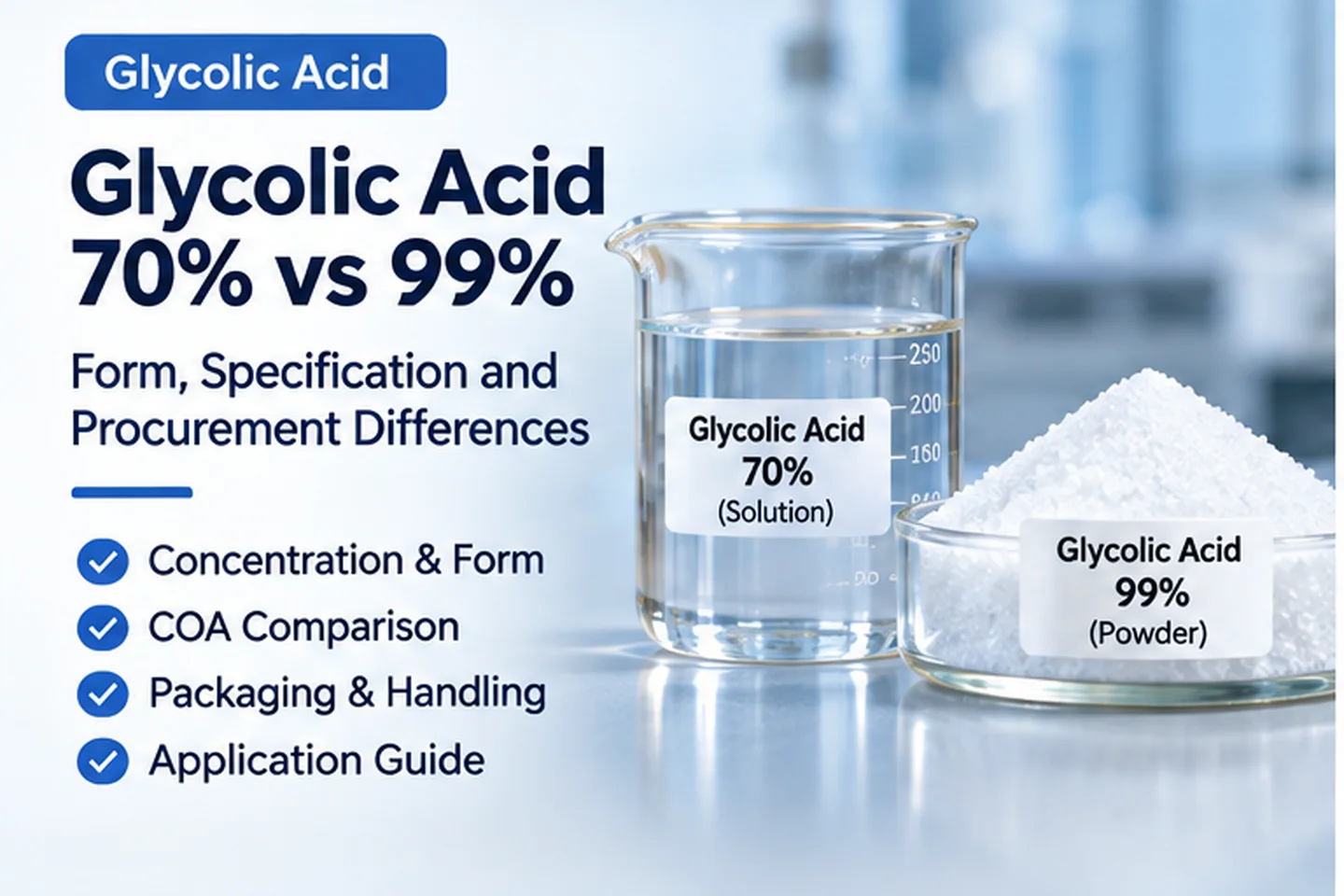
A 70% glycolic acid solution contains approximately 70% active glycolic acid by the stated assay basis, with water forming a substantial share of the supplied material. The 99% offer is supplied as white crystalline powder. For the same mass of product, the powder contains more glycolic acid and much less accompanying water, but it introduces its own unloading, dust control and dissolution considerations.
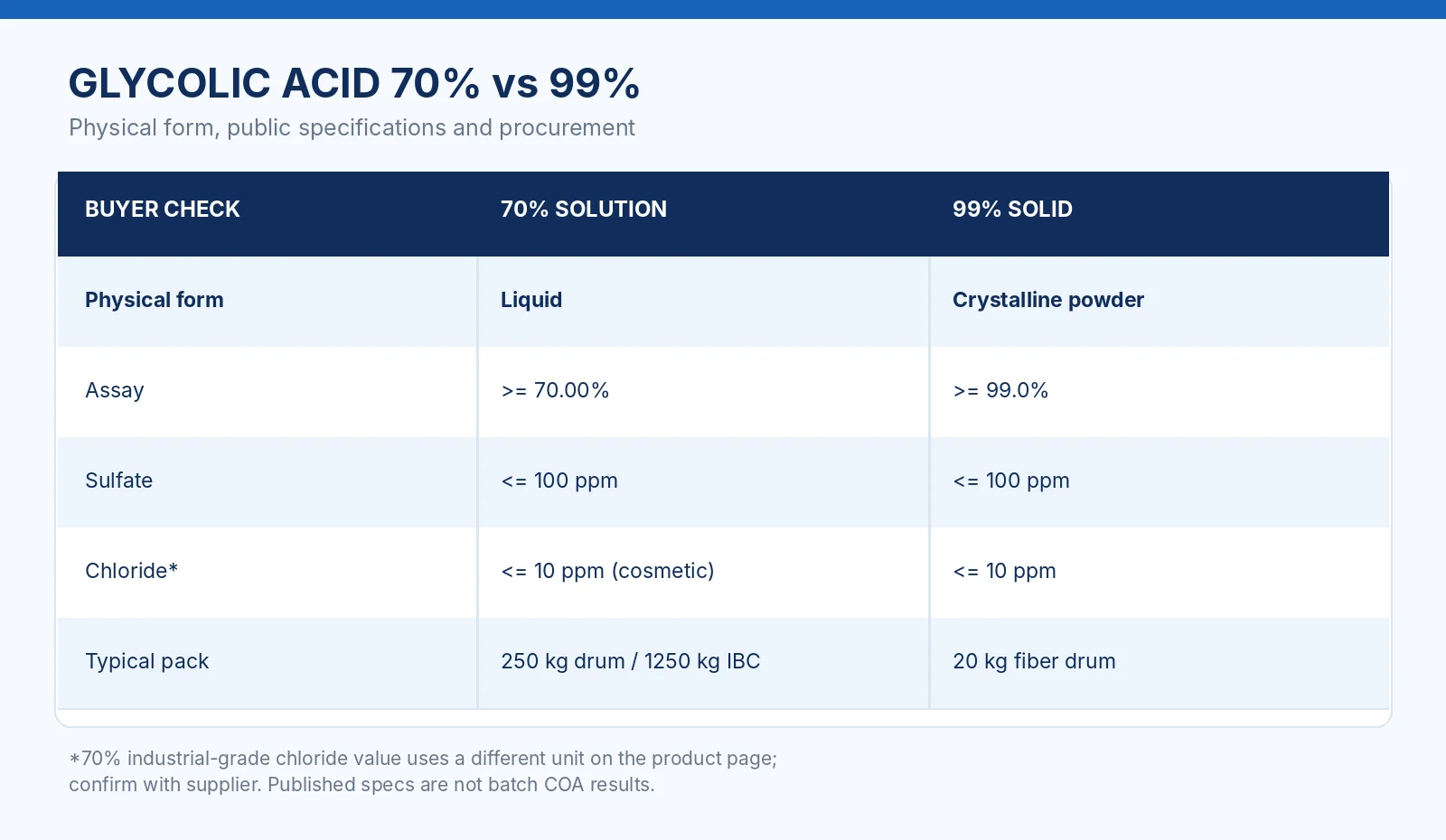
| Purchasing factor | Glycolic Acid 70% | Glycolic Acid 99% |
|---|---|---|
| Supplied form | Colorless to yellowish liquid | White crystal powder |
| Published assay | ≥70.00% | ≥99.0% |
| Typical commercial packing on site | 250 kg drum / 1250 kg IBC drum | 20 kg fiber drum |
| Process integration | Liquid metering, tanks and pumps | Solid addition or controlled pre-dissolution |
| Selection question | Can your process accept supplied water? | Can the plant safely handle and dissolve a solid? |
These physical differences may outweigh a small quoted price difference. A liquid line may benefit from direct pump dosing; a powder route may be preferred where moisture input, available storage space or the formulation sequence makes a concentrated solid more practical. Neither product form is automatically a higher quality grade for every use.
2. COA fields buyers should compare
Compare two documents separately: the grade specification, which states allowed ranges and limits, and the lot-specific COA, which shows actual results for the batch being shipped. Where one grade has an analytical field that is not listed for the other, request clarification rather than treating the missing value as zero.
| Test field | 70% solution: public page | 99% powder: public page | What to verify |
|---|---|---|---|
| Assay | ≥70.00% | ≥99.0% | Same unit and comparable assay basis |
| Appearance | Colorless/yellowish liquid | White crystal powder | Product form and visual acceptance |
| Chloride | ≤10 ppm (70% cosmetic grade) | ≤10 ppm | Grade and method; confirm 70% industry unit |
| Sulfate | ≤100 ppm | ≤100 ppm | Method and reporting basis |
| Iron / lead | Not specified in shown 70% table | Fe ≤10 ppm; Pb ≤10 ppm | Additional testing if required |
| Drying loss / ash | Ash shown ≤0.1 (unit not stated) | Loss on drying ≤0.50% | Confirm units, test method and applicability |
| Color | Gardner ≤3 | Not listed | Use grade-specific scale/method |
Important clarification on the 70% page
The supplier’s public 70% page gives markedly different chloride limits for cosmetic and industry grades, with different displayed units. It also lists an ash value without an explicit unit. Before setting an acceptance criterion, request an updated TDS/COA and written confirmation of the correct units and methods.
3. How concentration changes purchasing economics
Comparing only the purchase price per kilogram can distort a 70% versus 99% decision. The buyer also needs the delivered mass of active ingredient and the costs associated with transportation, unloading, storage, dilution and equipment compatibility.
Illustrative calculation: a 1,000 kg shipment at exactly 70% nominal assay represents approximately 700 kg of glycolic acid; a 1,000 kg shipment at exactly 99% represents approximately 990 kg. On that simplified basis, the effective product price per kilogram of active glycolic acid can be estimated by dividing the quoted price per kilogram by 0.70 or 0.99, respectively. Actual invoices, assay variation and other costs must be considered separately.
- Active-content basis: compare costs using a consistent assay basis, not different nominal product masses.
- Freight and packaging: include drums, IBCs, palletization, freight class and discharge expenses in the landed cost.
- Plant operations: budget for pumps and liquid storage versus solid-handling or dissolution operations.
- Qualification: include sampling, trial batches and any quality-control tests before switching supplied forms.
Do not assume that dissolving 99% powder produces a fully interchangeable version of every commercial 70% grade: impurities, color, supplied water quality and processing history may differ. Technical evaluation and formulation validation remain necessary.
4. Handling, storage and packaging questions
The site describes the 70% product in 250 kg drums and 1250 kg IBC drums. Its 99% product page identifies 20 kg fiber drums. These are published examples rather than a guarantee that every container option is available for every shipment. Ask for current net weight, container material, inner liner where applicable, loading plan and label/lot traceability.
For liquid Glycolic Acid 70%
- Can receiving equipment accept the proposed drum or IBC connection and unloading method?
- Is the tank, transfer line, gasket and pump material suitable for the supplied product?
- Will storage temperature, sealing and routine inspection follow the latest SDS and site procedures?
For crystalline Glycolic Acid 99%
- What packaging liner and moisture-protection approach is used for the solid?
- How will operators control dust and avoid contact during unloading and weighing?
- Is there an approved addition/dissolution procedure, with temperature and mixing controls validated by the plant?
These are procurement and EHS review prompts, not substitute handling instructions. The current supplier SDS and your facility’s risk assessment govern actual handling conditions.
5. Applications and grade-specific requirements
Glycolic acid is used in a range of chemical and formulation processes, but the target grade should always be selected according to what the finished process needs. The supplier describes 70% liquid uses including industrial cleaning and surface treatment, while its 99% page emphasizes the crystalline form and provides a separate specification for trace contaminants.
| Buyer use case | Likely discussion topic | Document to request |
|---|---|---|
| Industrial cleaning formulation | Concentration, chloride and material compatibility | 70% technical-grade TDS and SDS |
| Appearance-sensitive formulation | Color, iron and incoming test method | Relevant grade TDS plus lot COA |
| Specialty synthesis / limited-water process | High active-content feed and impurity controls | 99% lot COA and process qualification data |
| Formulation transfer from 70% to 99% | Dissolution, equivalent active dose, impurity profile | Trial sample, COAs for both forms |
For personal-care applications, procurement specifications alone do not establish legal or product-safety suitability. The formulator must evaluate ingredient quality, intended concentration and applicable jurisdiction-specific requirements. Avoid treating either 70% or 99% as directly usable in a finished product without appropriate formulation controls.
6. Which product URL should buyers visit?
If you are sourcing the crystalline material or need to review its listed trace-impurity limits, open the Glycolic Acid 99% crystalline powder product page. The page includes its assay, chloride, sulfate, iron, lead and loss-on-drying specifications.
If your process requires a ready-to-meter liquid, start with the Glycolic Acid 70% solution product page. It shows separate cosmetic and industrial columns and common packing formats. Ask the sales team to confirm any unit differences before using the values in a purchase order.
The older Glycolic Acid 70% components article contains a historical test example. That article is background reading, not a substitute for the latest grade specification or an upcoming shipment’s actual COA.
7. RFQ checklist and buyer FAQs
Before requesting a bulk quotation, send the supplier a short, decision-ready specification sheet:
- Requested form: 70% aqueous solution or 99% crystalline powder, including grade designation.
- Required assay and impurity limits, with units and preferred analytical methods.
- Expected monthly or annual volume, initial trial quantity and packaging preference.
- Required documents: current TDS, SDS, recent batch COA and sample availability.
- Destination port/country, requested Incoterm and target delivery window.
Is Glycolic Acid 99% always cheaper to ship?
Not necessarily. Higher assay means less inert water per kilogram of active substance, but total shipping and handling costs depend on package dimensions, shipment size, freight terms, local handling infrastructure and product pricing.
Can I directly replace 70% solution with 99% powder?
A substitution should be treated as a process change. Calculate the equivalent active ingredient, then validate dissolution, water balance, equipment, impurity profile, product quality and applicable safety procedures before approval.
Which COA should be used for final acceptance?
Use a lot-specific COA corresponding to the material shipped, checked against the current agreed purchase specification. Published product-page limits and a sample COA are useful for preliminary qualification, not final lot release.
Procurement takeaway
Select Glycolic Acid 70% or 99% by supplied form, tested quality and delivered cost per usable active ingredient. Confirm any ambiguous specification units before paying for or releasing the lot.
Request a product-specific COA/TDS and a bulk quotation
Tell our team your target concentration and grade, required specification limits, estimated quantity, packaging preference and destination for review.