Two Lauramine Oxide products can carry the same CAS number and still require different purchasing specifications. When evaluating a Lauramine Oxide 30% solution, procurement and quality teams need more than the concentration printed in a catalogue. Active matter, free amine, residual peroxide, pH, appearance and batch traceability must be reviewed against the intended application and the current supplier documents. This guide explains how to build an auditable Lauramine Oxide 30% specification and request a meaningful COA before committing to a bulk order.

1. Lauramine Oxide, LDAO and Naming Variants
Lauramine Oxide is a commonly used INCI name for an amine oxide surfactant identified by CAS 1643-20-5. Suppliers may also use the names lauryl dimethylamine oxide, lauryldimethylamine oxide, dodecyldimethylamine oxide, LDAO or DDAO. These names help buyers search for the chemical, but they do not confirm the commercial concentration, manufacturing grade or permitted application.
The active amine oxide is frequently supplied as an aqueous solution. Product titles such as “LDAO,” “OA-12” and “Laurylamine Oxide 30%” may refer to related offerings; however, buyers should confirm whether they describe the same approved commercial grade. Matching the CAS number alone is insufficient when specifications, impurity limits or packaging requirements vary across listings.
2. Active Matter: What “30%” Actually Measures
The “30%” in a Lauramine Oxide 30% product name normally refers to a nominal concentration of active surfactant in the supplied solution, usually expressed by mass. It should not be interpreted automatically as the guaranteed minimum, the measured result for every batch or the total nonvolatile solids of the formulation.
Check the reported basis and analytical method
Ask whether the result is reported as amine oxide active matter (% w/w), which molecular-weight basis is used in the calculation, and which validated analytical method establishes the value. Some technical sheets use an assay or titration procedure with a stated calculation basis. The phrase “total solids” is not automatically interchangeable with “amine oxide active”: dissolved salts and other nonvolatile constituents may be included in a solids measurement.
A useful COA includes the approved specification range, actual batch result, unit and method identifier. When comparing two quotations, request those fields for both products rather than comparing a rounded catalogue description with a laboratory result.
Why concentration affects procurement cost
Pricing per kilogram of solution can disguise a difference in delivered active material. For illustration only, a 1,000 kg consignment at a nominal 30% active concentration contains approximately 300 kg of active ingredient before accounting for the actual batch result. A buyer comparing offers should calculate cost per kilogram of verified active matter while also considering freight, packaging, process suitability and documented quality. This is a calculation example, not a claimed specification for any offered lot.
3. Free Amine and Residual Peroxide: Critical Checks
Two products that meet the same active-content target may differ in residual components. For an amine oxide produced by oxidation of an amine precursor, free amine and residual peroxide are separate quality-control parameters. Their suitability depends on the actual application, analytical procedure and agreed acceptance criteria.
Free amine: residual precursor control
Free amine can indicate unconverted amine remaining in a commercial surfactant solution. Depending on formulation and concentration, this may matter for odour, compatibility and downstream product requirements. Ask whether the free-amine result is expressed as a mass percentage of the supplied material, which specific amine is used for the calculation, and whether the method is selective enough for the proposed grade.
A statement such as “low free amine” cannot replace a numerical acceptance limit. Buyers should obtain the intended limit from the agreed TDS or quality agreement and check the measured value on the actual lot COA.
Residual peroxide: distinguish the oxidant from the surfactant
Peroxide testing addresses residual oxidising material associated with the manufacturing and finishing process. The COA should identify whether the measurement is expressed as hydrogen peroxide equivalent, the reporting unit, the approved limit and the method used. A “peroxide value” with no stated basis is not sufficiently precise for comparing suppliers.
Do not assume that a product with a lower published peroxide number is necessarily better for every use. Review the batch result in context, then run relevant finished-formulation compatibility and stability testing. Strong claims about bleach stability or other performance should be substantiated for the specific grade and formulation.
4. pH, Appearance and Measurement Conditions
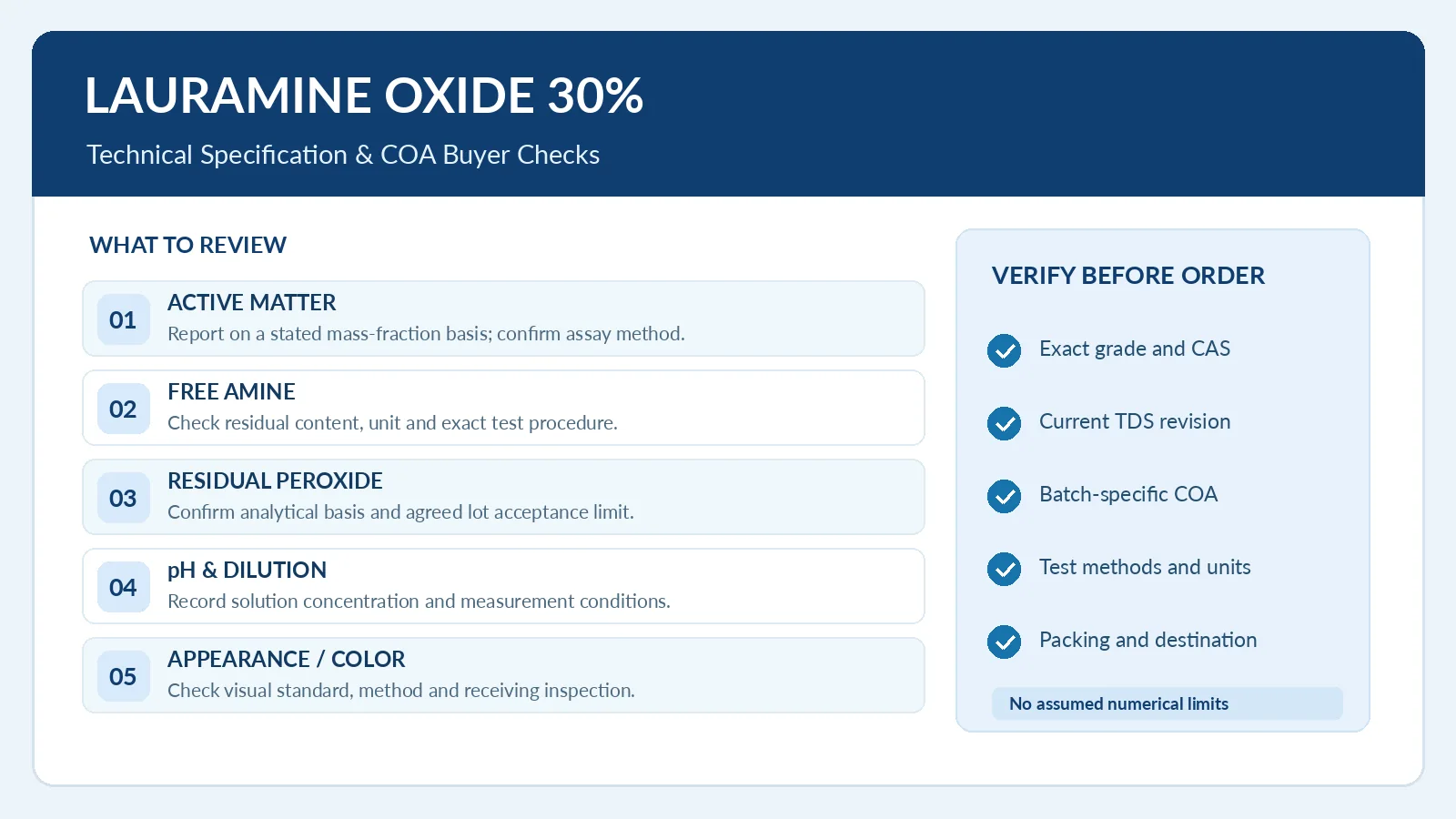
A published pH interval is meaningful only when the test conditions are clear. The pH of an as-supplied solution must not be compared directly with a value measured on a 5% or 10% aqueous dilution without examining the method. Record the sample preparation, dilution basis, water quality and measurement temperature, together with the resulting batch value.
Appearance and colour should also be reviewed consistently. Clear, colourless or pale-yellow descriptions may be appropriate for certain supplied grades, but visual assessment depends on lighting and the reference standard. Where colour is controlled through APHA/Hazen values, ask for the method and whether the certificate reports an actual result or a pass/fail statement.
When a delivered sample appears hazy, discoloured or different from the approved reference, preserve a sealed retention sample and request a documented investigation before releasing the material. A colour observation alone does not establish the cause of a batch difference.
5. How to Evaluate a Batch COA Against the Specification
The technical data sheet (TDS) describes the offered grade and its expected or controlled characteristics. A certificate of analysis (COA) should identify the production batch and show the laboratory findings for the tests actually performed. The safety data sheet (SDS) explains safety, handling and hazard information; it is not a replacement for batch release data.
Before approving a lot, compare each result with the specification agreed in the purchase order. If a field is absent or the test method differs, request clarification rather than assuming that the product passes. The table below is a document-review framework; no universal numerical limits are assigned.
| Review item | What the specification should state | What to verify on the COA |
|---|---|---|
| Identity / grade | INCI, CAS, grade code and concentration designation | Lot identity matches the quoted and labelled material |
| Active matter | Acceptance range, % w/w basis and assay method | Batch value, unit and test method |
| Free amine | Maximum allowed content and calculation basis | Actual result or defined reportable limit |
| Residual peroxide | Limit, reporting equivalent and analytical method | Lot result on the same stated basis |
| pH | Dilution, temperature and approved interval | Result measured under comparable conditions |
| Appearance / colour | Visual description or APHA/Hazen method | Batch observation, numeric result or pass/fail basis |
Documentation control matters as much as testing. Confirm the COA issuer, batch number, production or testing date, revision status and authorised approval. For a new supply relationship, request a representative historical COA for screening and then a current, shipment-specific COA for lot release. Never present a sample COA as proof that a future shipment has passed.
6. Formulation Suitability, Packing and Samples
Lauramine Oxide is commonly evaluated as a secondary surfactant or co-surfactant in dishwashing liquids, household cleaning products, hard-surface cleaners, shampoos and hand soaps. Depending on the system, it may support foam behaviour and viscosity development. The result is formulation-specific: salt level, pH, fragrance, co-surfactants, concentration and processing conditions all influence performance.
For household and institutional cleaning, ask the technical team to assess detergency, foam profile, thickening response and compatibility with the complete cleaner formulation. For personal care, evaluate the particular rinse-off system, sensory response, safety assessment and applicable market requirements. Neither a general product-page description nor a surfactant name establishes suitability for food contact, antimicrobial claims or every cosmetic application.
Qualification before a full-container purchase
- Approve a traceable sample. Request the sample batch number and matching COA, then test it against your current reference under equivalent conditions.
- Agree on a release specification. Document the parameters, methods, limits and corrective-action process before the purchase order is issued.
- Confirm available packing. Ask whether drums or IBCs are available for the requested grade; specify net weight, container material, seals and palletisation.
- Check storage and shipping. Obtain the current SDS/TDS instructions, destination documentation, shelf-life basis and transport conditions.
- Verify the shipped lot. Match container labels, quantity, lot numbers and COA to the order and the approved sample record.
7. Supplier Questions and Bulk RFQ Template
A useful purchasing inquiry should make technical and commercial acceptance criteria visible from the start. Ask these questions before you compare unit prices:
- Identity: Which exact Lauramine Oxide 30% grade code and CAS/INCI declaration are offered?
- Active content: What is the approved active-matter range, reporting basis and test method?
- Residual controls: What limits and methods apply to free amine and peroxide for this grade?
- pH and appearance: Which dilution and colour standard are used to release the batch?
- Documents: Can you supply a current TDS, SDS and a representative COA, followed by the actual shipped-lot COA?
- Supply terms: What are the available packing options, MOQ, sample size, lead time and export documents?
- Destination: What is the quotation for our order quantity, destination and requested Incoterm?
Subject: RFQ — Lauramine Oxide 30% (CAS 1643-20-5) — [Quantity] — [Destination]
Hello, we are reviewing Lauramine Oxide 30% for a [household cleaning / personal-care] formulation. Please confirm the exact grade code, available packing and current technical specification. We would like to review the active-matter test basis, free-amine and peroxide limits, pH measurement conditions and the applicable analytical methods.
Please provide the latest TDS and SDS, a representative batch COA, sample availability and a quotation for [quantity] delivered to [destination] under [Incoterm]. We will approve the offered grade after reviewing documentation and sample test results. Thank you.
8. Frequently Asked Buyer Questions
Is Lauramine Oxide the same as LDAO or Laurylamine Oxide?
The names are often used for the same underlying chemical identified by CAS 1643-20-5, but commercial solutions and grade specifications still need to be checked separately. Ask for the manufacturer’s precise grade designation.
Does “30%” guarantee every batch contains exactly 30% active matter?
No. It is commonly a nominal product description. The authorised specification states the acceptance range, and a batch COA should provide the measured result according to a defined method.
Why review free amine and peroxide separately?
They represent different residual components and require different analytical methods. Each must be compared with its own agreed specification limit rather than inferred from the total active-matter result.
Can pH figures from different suppliers be compared directly?
Only when sample preparation and measurement conditions are comparable. A pH value on a diluted solution and one measured as supplied may not have the same interpretation.
What is the minimum document package before a bulk order?
Request the exact-grade TDS, current SDS, representative COA, packing information and a shipment-specific COA at dispatch. Add regulatory or application-specific declarations when required by your market.
Provide your target Lauramine Oxide grade, application, quantity, preferred packing and destination. We can confirm the documentation available for the offered material before you qualify a commercial lot.
Request Documents & a QuoteThese product pages use related names and CAS information. Please request a current grade-specific TDS/COA before treating their published specifications as interchangeable.
Last content review: November 2026. Product claims, concentrations and acceptance criteria must be confirmed against current commercial documentation before purchase or publication as guaranteed specifications.